
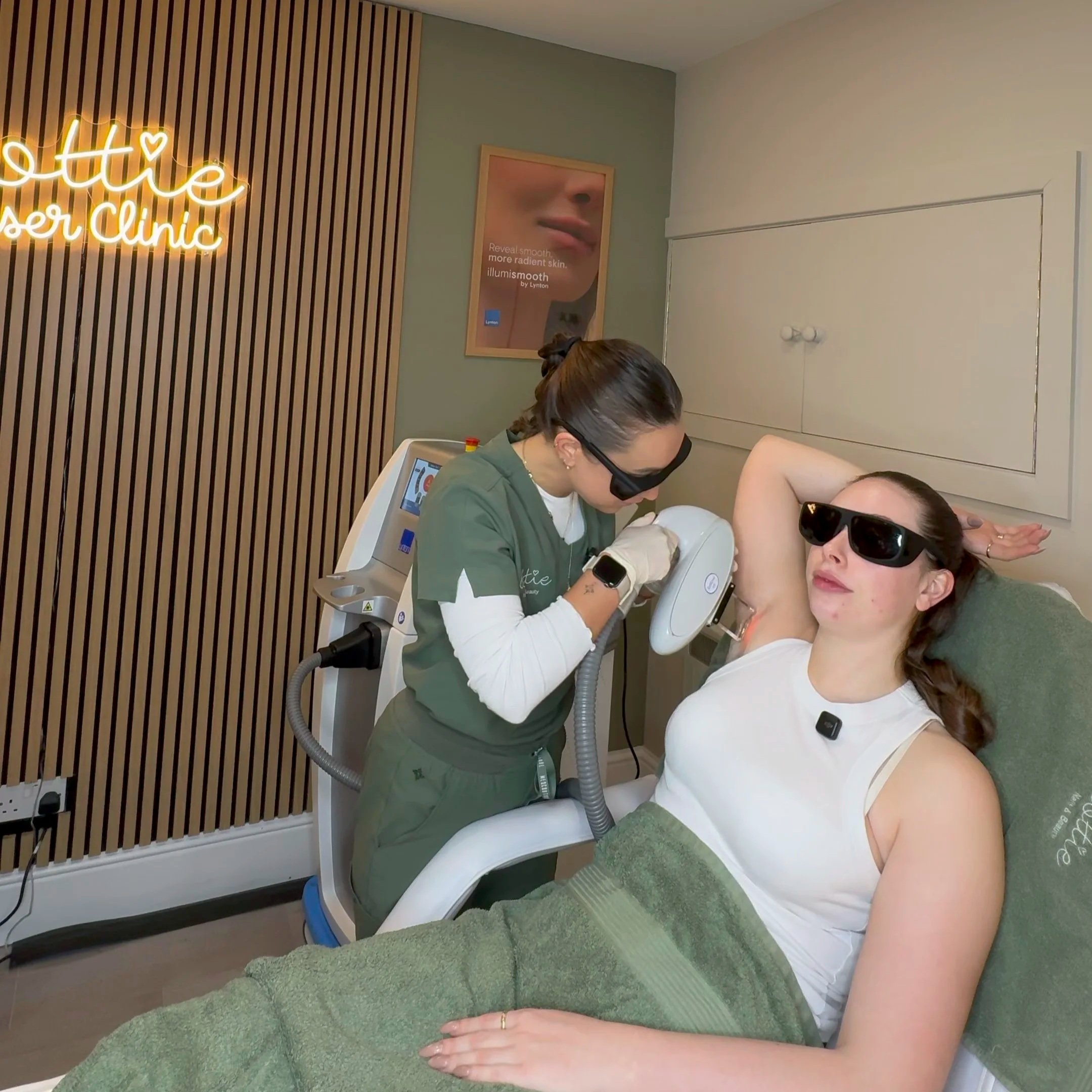
Laser IPL underarm hair removal performed by Lottie using the Lynton Dynamix remove650
It's one of the first questions almost everyone asks before booking laser hair removal at Lottie Laser Clinic. Is it actually permanent, or will the hair just grow back. It's a fair question, and the honest answer is more nuanced than the marketing you'll see from some providers.
You'll find clinics advertising "permanent hair removal" as though every hair disappears forever after a course of treatment. That's not quite how it works, and any clinic being straight with you will explain the difference. The reality is genuinely good news for most people, but it's worth understanding properly so you know what to expect.
This guide gives you the honest answer, explains the important difference between permanent removal and permanent reduction, and sets out what results you can realistically expect from a course of treatment at our clinic in Crawshawbooth, Rossendale.
Laser hair removal provides permanent hair reduction rather than permanent hair removal. The treated hair is significantly and permanently reduced, but some regrowth is possible over time, particularly due to hormonal changes. Most clients enjoy long-lasting, smooth results with only occasional top-up sessions needed to maintain them.
Is laser hair removal permanent?
The honest answer is yes and no.
Laser hair removal provides permanent hair reduction. Many effectively treated hairs are disabled long-term and do not typically return. However, hormonal changes can stimulate new hair growth over time.
This is why the clinically correct term is permanent hair reduction rather than permanent hair removal.
Most clients enjoy smooth skin for years with only occasional maintenance sessions.
Key takeaways
| What matters | Why it matters |
|---|---|
| The correct term is "permanent hair reduction" | This is the clinically accurate and legally recognised term. It means a long-lasting, significant reduction in hair, not necessarily total removal forever. |
| Treated hair does not usually return | When a follicle is properly treated during its active growth phase, that hair is disabled long-term and does not typically grow back. |
| Some regrowth is still possible | Hormones, new follicle activity and the body's natural changes mean occasional new hair can appear over months or years. |
| Results last a long time | Most clients see smooth results for years, with only occasional top-ups needed to maintain them. |
| Hormonal areas need more maintenance | Facial hair and hormonally influenced areas often need more regular top-ups than areas like legs or underarms. |
| Honest clinics explain this upfront | Any clinic promising total permanent removal forever is overselling. The honest promise is significant, long-lasting reduction. |
Permanent removal versus permanent reduction
This is the single most important distinction to understand, and it's where a lot of confusion comes from.
The clinically accurate, regulated term for what laser and IPL treatments achieve is permanent hair reduction. This is the language used by regulatory bodies and reputable manufacturers, and it's deliberately specific. It means a significant, long-lasting reduction in the number of hairs that grow back, not a guarantee that every single hair will be gone forever.
Permanent hair removal, taken literally, would mean no hair ever growing back in the treated area. No reputable treatment can honestly promise that, because your body can always produce new hair growth under certain conditions, particularly hormonal ones.
So when you see "permanent hair removal" advertised, what's actually being delivered, if the clinic is good, is permanent hair reduction. The difference matters because it sets realistic expectations. The good news is that for most people, permanent reduction means smooth, hair-free skin for years with very little maintenance, which is exactly the result they wanted in the first place.
What permanent hair reduction actually means in practice
For the vast majority of clients, a completed course of laser hair removal delivers a dramatic, lasting change. Here's what that looks like in real terms:
- The large majority of treated hair is permanently gone after a full course.
- Any hair that does eventually return is typically much finer, lighter and sparser than before.
- The smooth result lasts for years, not weeks or months.
- Maintenance is minimal, usually an occasional top-up session rather than ongoing regular treatment.
- Many clients on body areas like legs and underarms go very long periods between any top-ups at all.
In other words, the honest version of the answer is still an excellent one. You're not signing up for endless treatments forever. You're aiming for a long-lasting result that holds with minimal upkeep.
What percentage reduction can you expect?
Most clients experience significant long-term hair reduction after a full course of treatment. Putting a realistic number on it helps set expectations.
Results depend on several factors:
- Hair colour
- Hair thickness
- Treatment area
- Hormonal influences
- Completing the full recommended course
Many suitable clients can achieve around 70 to 90 percent long-term hair reduction after completing a full course, although individual results vary. Any remaining hair is typically finer, lighter and far less noticeable than before. A consultation and patch test is the only way to get a realistic picture for your own skin and hair.
Why some regrowth can happen
Understanding why hair can return helps explain why "reduction" is the honest word. There are a few reasons.
Hormonal changes
Hormones are the biggest factor. Pregnancy, menopause, perimenopause, polycystic ovary syndrome (PCOS) and certain medications can all stimulate new hair growth, sometimes in areas that were previously treated successfully. This is your body producing new hair activity, not the old treated hairs coming back. It's also why facial and hormonally influenced areas often need more ongoing maintenance.
Dormant follicles becoming active
Not every hair follicle is active at the same time. Some follicles that were dormant during your original course can become active later, producing new hairs that weren't there to be treated first time round. This is normal and is easily managed with occasional top-up sessions.
Incomplete original courses
If someone stops their course early, before the full set of sessions is complete, more hair is likely to remain or return simply because not all the follicles were treated across enough growth cycles. Completing the recommended course is important for the best lasting result. Our guide on how many sessions you'll need explains this in more detail.
How laser and IPL achieve lasting results
To understand why the results last, it helps to know what's actually happening during treatment.
Laser and IPL hair removal works by delivering controlled light energy that is absorbed by the melanin (pigment) in the hair. That energy converts to heat, which damages the hair follicle at the root. When a follicle is properly treated during its active growth phase, it's disabled and does not typically produce hair again.
The reason a course of treatments is needed, rather than a single session, is that only a portion of your hair is in the active growth phase at any one time. Spacing sessions across several weeks allows different hairs to be caught in their active phase. Once a follicle has been effectively treated, that particular hair is gone for good. This is why the result is genuinely long-lasting rather than temporary.
The consistency and quality of the energy being delivered makes a real difference here. This is one of the areas where medical-grade technology stands apart from cheaper alternatives.
Why the technology affects how long results last
The more consistently and effectively a follicle is treated, the more likely it is to be disabled long-term. Inconsistent or underpowered energy delivery can leave follicles damaged but not fully disabled, which means hair is more likely to return.
Why we use it
Lynton Dynamix IPL
Medical-grade IPL system manufactured in the UK by Lynton Lasers, refined over 30 years of clinical IPL development. Trusted by NHS organisations and aesthetic professionals across the UK. Highly calibrated and tightly controlled energy output, refined by DynamicReflex Technology, with settings tailored to each skin type and hair characteristic. Consistent, effective energy delivery is one of the keys to achieving genuinely long-lasting hair reduction.
Combined with a properly planned course and experienced technique, this is why many clients at Lottie Laser Clinic achieve significant long-term reduction that holds well for years. If you'd like to understand the wider difference equipment makes, our article on why cheap laser hair removal is not always better covers it in detail.
Want to know what results you could expect?
Book a consultation and patch test at Lottie Laser Clinic in Crawshawbooth, Rossendale, and receive a personalised treatment plan based on your skin type, hair type and treatment goals.
Book your consultationHow long do laser hair removal results actually last?
This is the practical question behind the headline one. Here's a realistic guide to how long laser hair removal results tend to last by area.
| Area | What to expect long-term |
|---|---|
| Legs | Often the longest-lasting results. Many clients go years between top-ups, if they need them at all. |
| Underarms | Strong, long-lasting results. Occasional top-ups maintain smoothness. |
| Bikini line | Long-lasting for most clients, with occasional maintenance to manage any new growth. |
| Face (upper lip, chin) | Hormonally influenced, so more likely to need regular top-ups to maintain the result. |
| Back, chest | Generally long-lasting for darker, coarser hair, with occasional maintenance. |
The pattern is consistent. Non-hormonal areas tend to deliver the longest-lasting results, while hormonally influenced areas like the face benefit from a little more ongoing maintenance. None of this means the treatment hasn't worked. It's simply how hair growth behaves in the body.
Why some people think laser hair removal isn't permanent
You'll occasionally hear someone say laser hair removal "didn't work" or "didn't last" for them. In most cases, there's a specific reason behind it rather than a problem with the treatment itself. The most common ones are:
- Stopping treatment too early. Hair grows in cycles, so a full course across several sessions is needed to catch follicles in their active phase. Stopping partway through leaves untreated follicles that continue to grow.
- Low-quality equipment. Underpowered or poorly calibrated devices may only damage follicles rather than disabling them, so hair returns. This is one of the most common reasons people are disappointed with cheaper providers.
- Hormonal changes. Pregnancy, menopause, perimenopause and conditions like PCOS can stimulate new hair growth that wasn't there during the original course. This is new activity, not the old hair returning.
- Unrealistic expectations. If someone expects every single hair gone forever after one course, even an excellent result can feel like a letdown. The honest goal is significant long-term reduction.
- Poor treatment planning. Incorrect settings, sessions spaced wrongly or an inadequate assessment can all reduce how effective and lasting the results are.
Almost all of these come down to either the quality of the clinic and equipment or expectations that were never set honestly in the first place. With the right technology, a complete course and realistic expectations, laser hair removal delivers genuinely long-lasting results for the large majority of clients in Rossendale and across Lancashire.
Why honesty matters when choosing a clinic
The way a clinic answers this exact question tells you a lot about whether you can trust them. Here's what to look out for:
- Claims of guaranteed permanent removal forever. No honest clinic can promise this. The accurate term is permanent hair reduction, and a good clinic will use it.
- No mention of top-ups or maintenance. A clinic that doesn't explain that occasional maintenance may be needed isn't giving you the full picture.
- No discussion of hormonal factors. Hormones are central to long-term results, particularly for women. A proper consultation should cover this.
- Pressure without realistic expectation setting. Beware of high-pressure sales that focus on the dream result without explaining what's realistic for your skin, hair and circumstances.
At Lottie Laser Clinic, we'd always rather give you the honest answer than the one that closes a sale. Setting realistic expectations is part of treating people properly, and it's why so many of our clients come to us after disappointing experiences with providers who overpromised.
Treatments at Lottie Laser Clinic
Alongside laser hair removal, the same medical-grade Lynton platform delivers a full range of skin and aesthetic treatments at our Rossendale clinic.
Full details of our medical-grade IPL hair removal treatments, including areas treated, sessions required and what to expect at your consultation and patch test.
Find out more → Skin rejuvenation IllumiFacialMedical-grade IPL skin treatment for pigmentation, redness, uneven tone and overall complexion clarity.
Find out more → Even skin tone Pigmentation RemovalTargeted laser pigmentation treatment for sun spots, age spots, freckles and uneven pigmentation.
Find out more → Combination treatment IllumiSmoothA two-phase treatment combining IPL with fractional resurfacing for skin clarity, tone and texture.
Find out more →Why clients across Lancashire choose Lottie Laser Clinic
★★★★★ Rated 5.0 from 42 Google Reviews
We work with clients from Rossendale, Rawtenstall, Haslingden, Burnley, Blackburn, Ramsbottom and across the wider Lancashire area. What our clients value:
- Medical-grade Lynton IPL technology. Trusted by NHS organisations and aesthetic professionals across the UK.
- Consultation and patch test. A £30 consultation and patch test appointment, with no obligation to book a course.
- 15+ years of professional therapist experience. Lottie Dalton personally assesses, plans and delivers your treatment, and is currently completing her Level 4 qualification in laser and IPL.
- Honest, realistic advice. We tell you what results you can genuinely expect, not what sounds best.
- Long-term value. Most clients achieve significant lasting reduction with only occasional top-ups.
Frequently asked questions
Is laser hair removal permanent?
Laser hair removal provides permanent hair reduction rather than permanent removal. The treated hair is significantly and permanently reduced, and most clients enjoy smooth results for years. Some new growth is possible over time, particularly due to hormonal changes, which is why occasional top-ups are sometimes needed.
What is the difference between permanent hair removal and permanent hair reduction?
Permanent hair reduction is the clinically accurate, regulated term. It means a significant, long-lasting reduction in hair growth. Permanent hair removal, taken literally, would mean no hair ever returning, which no honest treatment can guarantee because the body can always produce new hair under certain conditions.
Will the hair grow back after laser hair removal?
Hair that is properly treated during its active growth phase does not typically grow back. However, new hair can appear over time due to hormonal changes or previously dormant follicles becoming active. Any regrowth is usually much finer and sparser, and is easily managed with occasional top-up sessions.
How long do laser hair removal results last?
Most clients see smooth results lasting years. Non-hormonal areas like legs and underarms tend to last longest, often with very little maintenance. Hormonally influenced areas like the face may need more regular top-ups to maintain the result.
Why do I need top-up sessions if it's permanent?
Top-ups address new hair growth from hormonal changes or follicles that were dormant during your original course, rather than the original treated hairs returning. A single top-up once a year or less is very different from ongoing regular treatment, and most clients find maintenance minimal.
Does hormonal hair respond to laser hair removal?
Yes, laser and IPL work well on hormonal hair, but because hormones can keep stimulating new growth, hormonally influenced areas such as the face often need more ongoing maintenance. We'll discuss this honestly at your consultation so you know what to expect.
Can laser hair removal work on blonde, grey or red hair?
Laser and IPL target the melanin (pigment) in hair, so they work best on darker hair. Blonde, white, grey and red hair contain little melanin and often respond poorly. We'll give you an honest assessment of suitability at your consultation and patch test appointment.
Is laser hair removal popular in Rossendale?
Laser hair removal is one of the most requested treatments at Lottie Laser Clinic, with clients travelling from Rossendale, Rawtenstall, Haslingden, Burnley and across Lancashire for treatment.
Do you treat clients from across Lancashire?
Yes. We're based in Crawshawbooth, Rossendale, and see clients regularly from Rawtenstall, Haslingden, Burnley, Blackburn, Ramsbottom and across the wider Lancashire area. Get in touch to arrange your consultation and patch test.